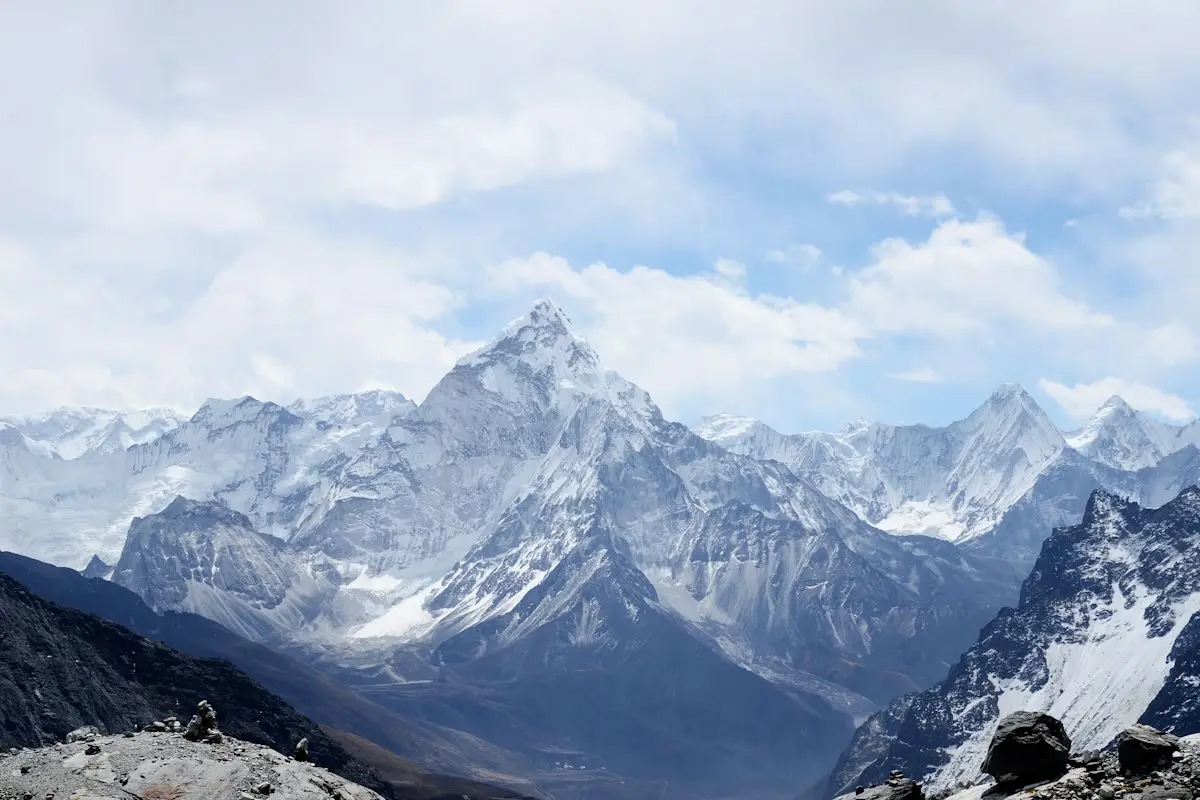
Gilgit-Baltistan is the mountain region in the far north of Pakistan, bordering China, Afghanistan's Wakhan Corridor and Kashmir. It covers about 72,971 square kilometres and holds some of the highest mountains on earth, including K2 (8,611 m), the second-highest peak in the world, and Nanga Parbat (8,126 m). Five of the world's fourteen 8,000-metre peaks stand here. The capital is Gilgit, and the main travel hubs are Gilgit, Hunza (Karimabad) and Skardu.
Where three great mountain ranges meet
Near Jaglot, on the Karakoram Highway south of Gilgit, the Karakoram, the Himalaya and the Hindu Kush meet at a single point, close to where the Gilgit River joins the Indus. Few places on earth let you stand at the junction of three major ranges. The Karakoram holds the longest glaciers outside the polar regions, including the Baltoro, Biafo and Hispar glaciers.
The main regions to visit
- Hunza and Nagar: Karimabad, Baltit and Altit forts, Attabad Lake, Passu Cones, Hussaini Bridge, Eagle's Nest and the road to Khunjerab Pass (4,693 m) on the China border.
- Skardu and Baltistan: Shangrila and Upper Kachura lakes, the Sarfaranga cold desert, Shigar and Khaplu forts, and the gateway to K2 and the Baltoro Glacier.
- Deosai National Park: one of the highest plateaus in the world, averaging over 4,000 m, home to the Himalayan brown bear and Sheosar Lake.
- Fairy Meadows: a high meadow facing the Rakhiot face of Nanga Parbat, reached by jeep from Raikot Bridge and a short hike.
- Gilgit, Naltar, Ghizer and Phander: forests, coloured lakes and trout rivers on the road west towards the Shandur Pass.
- Astore and Rama: pine meadows and Rama Lake below the eastern side of Nanga Parbat.
When to go
Spring (April to May) brings cherry and apricot blossom in Hunza. Summer (June to August) opens every road, including Deosai, Babusar Pass and the high treks. Autumn (September to early November) is clear, quiet and famous for golden poplars in Hunza. Winter (December to March) is for snow lovers: valleys stay reachable but high passes close and flights cancel more often.
How to get there
Most travellers start in Islamabad. Daily flights reach Gilgit and Skardu in about an hour each, but they depend on clear weather and are often delayed or cancelled. By road, the Karakoram Highway (KKH) reaches Gilgit in roughly 14 to 18 hours. In summer the faster route crosses the Babusar Pass (4,173 m) through the Kaghan Valley. Skardu is about five hours' drive from Gilgit along the Indus.
How many days you need
- 5 days: Hunza only, with Attabad Lake and a day trip to Khunjerab.
- 7 days: Hunza and Skardu, or Hunza and Fairy Meadows.
- 10 days: Hunza, Skardu, Deosai and Shigar, with buffer days for weather.
- 14 days or more: add a trek such as Fairy Meadows, Rakaposhi Base Camp or the Baltoro towards K2.
Practical essentials
- Money: the currency is the Pakistani rupee (PKR). ATMs work in Gilgit, Aliabad and Skardu; carry cash for remote valleys.
- Mobile signal: SCOM has the widest coverage; Jazz, Zong and Telenor work in the towns. Foreign visitors register a SIM with their passport.
- Documents: foreign visitors need a Pakistan visa (most nationalities apply online) and should carry passport copies for police checkpoints on the KKH.
- Altitude: most towns sit between 1,500 and 2,500 m, but Deosai, Khunjerab and the treks go above 4,000 m. Ascend gradually.
- Roads: landslides can block the KKH or the Skardu road for hours, especially in July and August. Keep a buffer day.
“The north rewards slow travel. Every extra day buys you another valley, another village invitation and a better chance of clear mountain views.”
Frequently asked questions
Where is Gilgit-Baltistan?+
Gilgit-Baltistan is the northernmost region of Pakistan. It borders China's Xinjiang to the north, Afghanistan's Wakhan Corridor to the north-west and Kashmir to the south and east. Its capital is Gilgit.
What is the best time to visit Gilgit-Baltistan?+
April to October. April and May bring blossom, June to August opens every road and trek, and September to early November offers clear skies and autumn colours in Hunza.
How many days do I need for Gilgit-Baltistan?+
Plan at least 7 days for Hunza and Skardu, and 10 days or more to add Deosai, Shigar or Fairy Meadows with buffer days for weather and road closures.
Which famous mountains are in Gilgit-Baltistan?+
K2 (8,611 m), Nanga Parbat (8,126 m), Gasherbrum I (8,080 m), Broad Peak (8,051 m) and Gasherbrum II (8,035 m), plus Rakaposhi (7,788 m), Masherbrum and the Trango Towers.
Is Gilgit-Baltistan good for families?+
Yes. Hunza, Skardu, Shigar and Naltar have comfortable hotels and short walks. Keep high-altitude stops such as Deosai and Khunjerab brief for young children and older travellers.